
DFS Cash Games vs. GPPs: What’s the Difference?
Cash games and GPP tournaments require different DFS strategies. Learn how floor, ceiling, ownership, stacking, leverage and contest size should change the way you build lineups.
 By
By 
Daily fantasy gets a lot easier once you realize you are not supposed to build every lineup the same way.
DFS Cash Games vs GPPs comes down to one basic difference: cash games reward consistency, while tournaments reward lineups built to finish near the very top.
A lineup that makes perfect sense in a 50/50 can be pretty useless in a tournament with 50,000 entries. The players are the same. The salary cap is the same. The scoring is the same.
The goal is different.
That difference matters a lot.
Cash games are generally about building a lineup that can beat a meaningful chunk of the field consistently. GPPs are about building a lineup capable of finishing near the very top.
Those sound similar until you actually start constructing lineups.
Then they really, really don’t.
What Are DFS Cash Games?
“Cash games” is the common DFS term for contests with relatively flatter payout structures where you don’t need to finish near the top of a massive field to win money.
The most common examples are:
- Head-to-head: Your lineup against one other lineup.
- 50/50: Roughly the top half of the field wins the same prize.
- Double-ups: A similar concept where nearly half the field wins roughly double its entry fee.
DraftKings currently defines a 50/50 as a contest where lineups finishing in the top half win the same prize, and its Double-Up contests pay nearly half of the participants. FanDuel also currently offers head-to-head and 50/50 DFS formats.
The important part isn’t memorizing every contest label.
It’s understanding what you’re trying to accomplish.
In a 50/50, you don’t need the highest-scoring lineup.
You need a lineup good enough to finish above the cutoff.
If 100 people enter and roughly half get paid, finishing 12th and finishing 48th may produce the exact same result.
That changes how I think about the lineup.
What Is a GPP?
GPP stands for Guaranteed Prize Pool.
DraftKings defines a GPP as a tournament-style contest with a predetermined prize pool that is paid regardless of how many entries ultimately fill the contest.
These are the contests usually associated with the giant prizes you see advertised.
Thousands of entries.
Top-heavy payouts.
One lineup sitting at the top with a number next to it that makes you briefly wonder whether quitting your job and becoming a professional DFS player is a responsible financial plan.
It isn’t.
The important difference is that finishing slightly above average usually isn’t enough.
In a large tournament, you want a lineup with a realistic path to an unusually high score.
That’s a very different objective from surviving a cash-game cutoff.
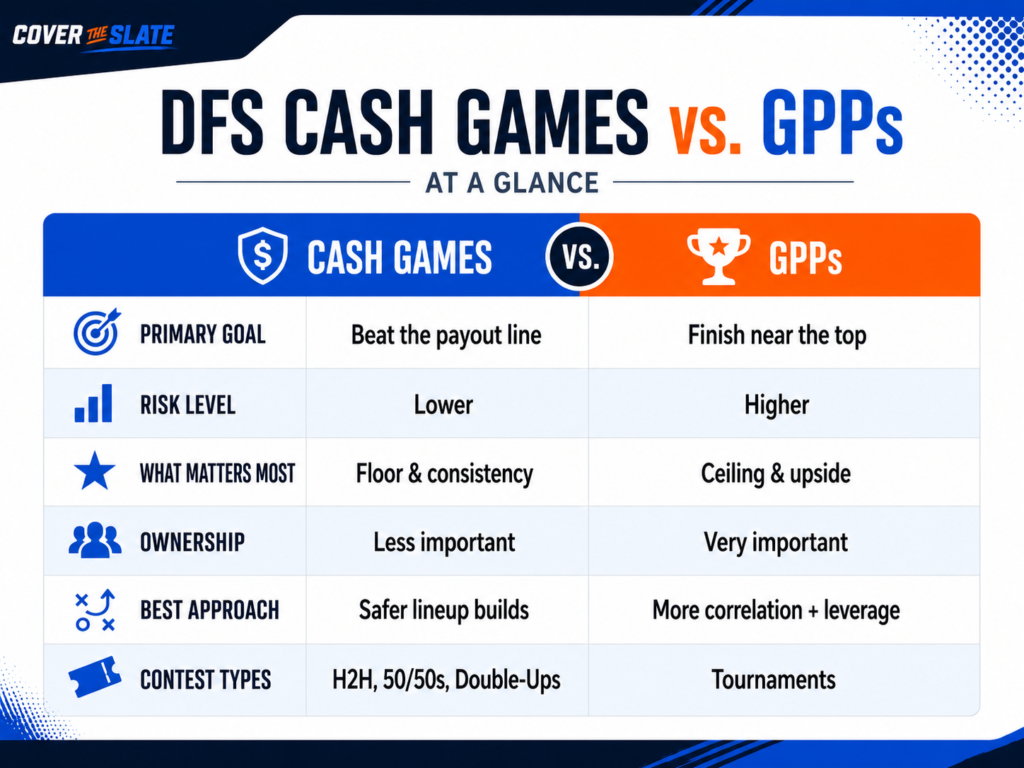
That’s the basic framework.
Now let’s get into why.
Cash Games: Floor Matters More
If I’m building a cash-game lineup, one of the first things I’m looking for is reliable opportunity.
Give me the running back expected to handle 18 carries and catch passes.
Give me the receiver regularly seeing eight or nine targets.
Give me the NBA player locked into 35 minutes.
I don’t necessarily need the guy whose fantasy production depends on catching a 70-yard touchdown.
Can he score more?
Absolutely.
Can he also spend three quarters doing cardio while I question every decision I’ve made since breakfast?
Also absolutely.
Cash lineups generally benefit from players with more predictable roles because the goal isn’t necessarily to produce the highest possible score.
It’s to avoid unnecessary ways for the lineup to fail.
GPPs: Ceiling Changes Everything
Tournaments are different.
If I’m trying to beat thousands of lineups, a roster full of guys who are “pretty solid” isn’t particularly exciting.
I want players who can wreck the slate.
That doesn’t mean randomly selecting volatile players.
It means asking a different question.
Instead of:
What is this player most likely to score?
I’m also asking:
What does it look like if everything goes right?
Suppose two receivers have similar projections.
Receiver A regularly gets short targets and usually lands somewhere between 12 and 18 fantasy points.
Receiver B has a deeper role and a wider range of outcomes. He might score six.
He might also score 35.
The first receiver may be more comfortable.
The second might be much more useful when first place is the objective.
Chalk Isn’t Automatically Bad
One of the first things DFS players learn is the word chalk.
Then some immediately decide chalk must be avoided at all costs.
That’s a mistake.
Chalk simply means a player is expected to be popular.
Sometimes a player is popular because the entire field has collectively lost its mind.
More often, he’s popular because he’s cheap, talented, in a great spot or getting a much larger role than his salary reflects.
In cash games, I generally don’t care much if a strong play is popular.
Actually, high ownership can sometimes reduce the damage if that player has a huge game because so many competing lineups roster him too.
In tournaments, ownership becomes much more interesting.
If a player is extremely popular and fails, every lineup that faded him gains ground on a large piece of the field.
That doesn’t mean:
High ownership = fade.
It means ownership becomes part of the decision.
What Is Leverage in a GPP?
Leverage is one of those DFS words that sounds much more complicated than it is.
Imagine a running back is expected to be one of the most popular players on the slate.
Now imagine his team’s passing game is largely ignored.
If the running back scores three touchdowns, you’re probably in trouble if you faded him.
But if the touchdowns come through the air instead, lineups using that team’s quarterback and receivers can gain while all those running-back lineups fall behind.
That’s a basic form of leverage.
You’re building around an outcome that benefits your lineup while hurting a popular competing construction.
That’s powerful in tournaments.
You usually don’t need to think that way nearly as much in cash games.
Why Stacking Matters More in GPPs
A stack uses players whose fantasy results are connected.
The classic NFL example is:
Quarterback + wide receiver
If the quarterback throws a touchdown to that receiver, both score points.
That’s correlation.
Now imagine the game turns into a 38-35 shootout.
Your quarterback scores 30 fantasy points.
Your receiver scores 28.
Maybe an opposing receiver scores 30 while his team is throwing constantly to keep up.
One game environment just drove three spots in your lineup toward ceiling performances.
That’s exactly the kind of outcome you’re hunting in tournaments.
The more players in your lineup can succeed together, the fewer separate things you may need to predict correctly.
You Don’t Need to Be Contrarian Everywhere
This is another mistake I see newer tournament players make.
They hear that GPPs require different lineups and suddenly decide they need nine players nobody else has heard of.
No.
A lineup can contain plenty of popular players and still be different enough from the field.
You might get unique through:
- one lower-owned player
- a different game stack
- a less popular quarterback
- a different roster construction
- leaving salary unused
- using two popular plays together in an uncommon combination
The point isn’t to create a lineup that looks insane.
The point is to create a lineup that can finish first without needing to split first place with 600 people who built the same damn thing.
Contest Size Matters Too
Not all GPPs are the same.
A 300-person single-entry tournament and a 100,000-entry tournament are technically both tournaments.
They should not necessarily produce the same strategy.
The larger the field, the more extraordinary your result generally needs to be to reach the very top.
That can push me toward:
- more ceiling
- stronger correlation
- more ownership awareness
- more unique roster construction
In a smaller tournament, I may not need to get nearly as weird.
This is why looking only at the contest’s name isn’t enough.
Look at the field size and payout structure.
Single-Entry vs. Multi-Entry Matters
Another important distinction is how many lineups each player can enter.
Single-entry
Every contestant can enter one lineup.
I like these for players who want tournaments without competing against someone’s 150-lineup portfolio.
You still need upside, but the field’s lineup construction can look different because everyone gets one shot.
Multi-entry
Players can submit multiple lineups up to the contest’s entry limit.
That gives experienced players the ability to spread exposure across different players, stacks and scenarios.
If you’re entering one lineup into a tournament where other players can enter dozens or hundreds, understand what you’re signing up for.
It doesn’t mean you can’t win.
It does mean you’re playing a different game than someone firing a large portfolio of lineups.
Should Beginners Play Cash Games or GPPs?
I don’t think there’s one correct answer.
It depends on what you want from DFS.
If your primary goal is learning lineup construction and giving yourself more frequent chances to cash, smaller-field contests and cash formats can make sense.
If what you enjoy is building one lineup and trying to turn a small entry fee into a huge result, you’re probably going to find tournaments more fun.
Personally, I’d rather a beginner understand both than decide one format is “correct.”
Play a few contests.
See what you enjoy.
Just don’t use the exact same strategy in both and wonder why something feels off.
Five Mistakes I’d Avoid
1. Trying to Get Cute in Cash Games
You usually don’t get bonus points for being the only person who rostered somebody.
If the obvious value is legitimately excellent, use him.
You don’t need to prove you’re smarter than everyone with every roster spot.
2. Building a Safe GPP Lineup
A lineup filled with players who all have decent floors can feel great.
It can also finish 4,812th.
Large tournaments reward exceptional scores.
Build accordingly.
3. Fading Chalk Just Because It’s Chalk
Ownership is information.
It isn’t an automatic instruction.
If a popular player is massively underpriced for his role, fading him solely because everyone else noticed is not galaxy-brain strategy.
Sometimes you’re just fading a good play.
4. Ignoring Contest Size
A lineup appropriate for a 200-person tournament might not be aggressive enough for a field with tens of thousands of entries.
Know who you’re trying to beat.
5. Entering the Wrong Contest
Contest selection is strategy.
If you’re entering one lineup, you may prefer single-entry or limited-entry tournaments over contests where experienced players can enter huge numbers of lineups.
The lobby matters before the games even start.
So Which Should You Play?
Here’s the easiest way I can put it.
Cash games: I want a lineup that’s hard to kill.
GPPs: I want a lineup that can kill everybody else.
Obviously we’re talking about a fantasy leaderboard here. Nobody call the cops.
Cash games generally reward consistency, opportunity and sensible value.
GPPs put more weight on ceiling, correlation, ownership and building a lineup capable of separating from the field.
Neither format is automatically better.
They’re just different games being played with the same players.
Once you understand that, DFS lineup construction starts making a hell of a lot more sense.