
DFS Ownership, Chalk & Leverage Explained
DFS ownership can completely change tournament strategy. Learn what chalk, projected ownership, leverage, fades and lineup duplication mean and how to use them in GPPs.
 By
By 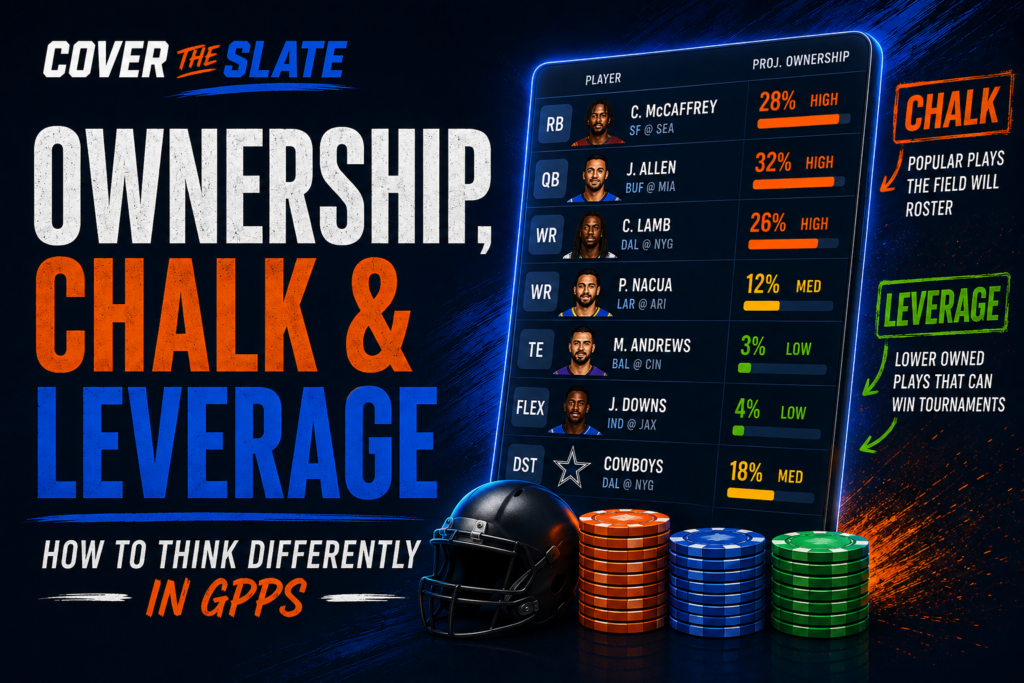
DFS gets more interesting once you stop looking at players in a vacuum.
A running back isn’t just a good play or a bad play.
He’s a good play at a certain salary, in a certain contest, with a certain percentage of the field expected to roster him.
That last part is ownership.
And once you understand ownership, a bunch of DFS language that sounds unnecessarily complicated starts making sense.
Chalk.
Contrarian plays.
Leverage.
Fading the field.
They’re all different pieces of the same basic idea:
Your lineup isn’t competing against a projection. It’s competing against other lineups.
What Is DFS Ownership?
Ownership is the percentage of lineups in a contest that roster a particular player.
If a player finishes at 25% ownership, one out of every four lineups in that contest used him.
Simple enough.
The important distinction is between projected ownership and actual ownership.
Projected Ownership
Before a contest starts, sites and DFS analysts estimate how popular each player will be.
That’s projected ownership.
It’s an estimate.
It can be very good. It can also be wrong.
News changes.
Lineups change.
People react differently than expected.
This is why I never want to talk about a player’s projected ownership as if it’s already a known fact.
Actual Ownership
Once the contest begins and lineups are visible under the contest’s rules, you can see how many entries actually rostered the player.
That’s actual ownership.
The difference matters because all of the strategy we’re talking about before lock is based on expectations about what everyone else will do.
What Is Chalk?
Chalk is DFS shorthand for a popular play.
There isn’t some universal ownership percentage where a player officially becomes chalk.
It’s relative to the slate.
A running back projected to be one of the two or three most popular players is chalk.
A cheap NBA starter expected to appear in a huge portion of lineups is chalk.
A golfer nobody wants to touch isn’t chalk just because 8% of the field uses him.
Context matters.
And this is the first rule worth remembering:
Chalk is not the same thing as a bad play.
A player often becomes popular because the case for rostering him is really strong.
Maybe he’s underpriced.
Maybe an injured teammate just opened up a huge role.
Maybe the matchup is excellent.
Maybe the projection models all love him.
Sometimes everybody sees the same thing because the thing is obvious.
Why People Get Chalk Wrong
Once DFS players learn about ownership, some immediately develop an allergy to popular players.
They start thinking:
Everyone is using this guy, so I need to fade him.
Not necessarily.
Imagine a cheap running back is suddenly expected to start and handle a huge workload.
His salary was set before the role changed.
Now he’s one of the best point-per-dollar plays on the slate.
Of course he’s going to be popular.
Fading him solely because he’s popular means you’re ignoring the reason he became popular in the first place.
DraftKings’ own DFS analysis has made a similar point: ownership is most useful when considered alongside a player’s chances of actually being an optimal play, rather than treated as a standalone number.
That’s the right way to think about it.
The question isn’t:
Is he chalk?
The question is:
Is he good enough chalk?
Good Chalk vs. Bad Chalk
This isn’t an official DFS classification. It’s just a useful way to think.
Good Chalk
A popular player whose salary, role and upside justify the ownership.
Maybe he’s too cheap.
Maybe his opportunity is unusually secure.
Maybe his ceiling is still strong enough that fading him creates more risk than reward.
I’m perfectly comfortable eating that chalk.
Fragile Chalk
A popular player whose projection looks good but whose path to getting there feels less secure.
Maybe:
- the workload could be split
- the player needs extreme efficiency
- there are strong alternatives at similar salaries
- the matchup introduces real downside
- the field may be overreacting to one recent game
That’s where fading gets more interesting.
I’m not fading because the player is popular.
I’m fading because I think the field is more confident than it should be.
That’s a very different argument.
What Does It Mean to Fade a Player?
A fade simply means you’re choosing not to roster someone.
If the most popular running back is in 35% of lineups and you don’t use him, you’ve faded him.
That doesn’t automatically give you an advantage.
He still has to fail relative to the alternatives.
If the chalk running back scores 35 fantasy points and your pivot scores nine, congratulations on your impressive display of independence.
You’re still losing.
A fade becomes valuable when:
- A popular player underperforms.
- Your alternative performs well.
You need both sides of that equation.
What Is Leverage?
Leverage is one of the most important tournament concepts in DFS.
In simple terms:
Leverage means building a lineup that benefits when a popular competing outcome fails.
Let’s use an NFL example.
Suppose a team’s running back is expected to be extremely popular.
The field is basically betting that this team’s offense produces through him.
Instead, you roster the quarterback and a lower-owned receiver from the same team.
Now imagine the offense scores four touchdowns.
But three come through the passing game.
Your lineup is scoring.
The popular running-back lineups are not getting the outcome they needed.
That’s leverage.
DraftKings tournament content regularly frames lower-owned alternatives and different roster constructions as ways to gain on the field when popular plays fail.
Leverage Isn’t Just Picking Low-Owned Players
This is an important distinction.
A player being 2% owned does not automatically make him a great tournament play.
Sometimes he’s 2% owned because he has a terrible role and shouldn’t be in your lineup.
Low ownership by itself has no magical value.
I want:
Low ownership + a legitimate path to a ceiling score.
That’s much more interesting.
The goal isn’t to find players nobody wants.
It’s to find good outcomes the field may be underestimating.
The Best Leverage Can Come From Roster Construction
You don’t always need some obscure player to make a lineup different.
Suppose most of the field is paying up at running back.
You might pay up at wide receiver instead.
Or maybe everyone is using the same cheap quarterback to afford expensive skill players.
You spend more at quarterback and build differently everywhere else.
Now your lineup can become naturally unique without forcing a bad individual play.
Leverage can come from:
- player selection
- salary allocation
- stacks
- game selection
- positional construction
- leaving salary unused
- combinations of otherwise popular players
Sometimes the best contrarian decision isn’t a weird player.
It’s a normal player used in a lineup the field isn’t building.
Ownership Matters More in GPPs
Ownership is generally much more important in tournaments than in cash games.
In cash, your primary goal is beating a payout line.
If an excellent value play is extremely popular, I’m usually not looking for excuses to avoid him.
If he succeeds, the huge ownership means most competing lineups got the same benefit.
In a GPP, particularly a large one, your goal is different.
You’re trying to finish near the top.
If your lineup is almost identical to thousands of other entries, separating becomes much harder.
That’s why large-field tournament strategy puts more emphasis on ownership, leverage and contrarian roster construction. DraftKings’ tournament strategy content makes the same connection between ownership leverage and building for first place rather than simply min-cashing.
Field Size Changes How Much Ownership Matters
Imagine entering two tournaments.
One has 200 lineups.
The other has 75,000.
Do you need the same amount of differentiation?
Probably not.
In the smaller field, you may be able to roster many of the strongest obvious plays and differentiate in only one or two spots.
In a massive field, there are far more competitors building similar combinations.
Now lineup uniqueness matters more.
This does not mean larger field equals roster nine maniacs.
It means the number of people you’re trying to beat should influence how much you’re willing to deviate from the field.
Don’t Add Ownership Percentages Together Like a Magic Formula
You’ll sometimes see players calculate the combined ownership of their lineup.
That can provide context.
It can also create false precision.
A lineup with a lower combined ownership number isn’t automatically better than one with a higher number.
Ownership isn’t independent across every player.
Certain players naturally get rostered together because of:
- stacking
- salary construction
- positional combinations
- game environments
The actual question remains:
How likely is this lineup to be duplicated, and does it have enough upside to matter if it isn’t?
That’s more useful than trying to hit some arbitrary ownership total.
Duplication Matters
Suppose you enter a huge tournament and build the perfect lineup.
First place.
Beautiful.
Except 87 other people built the exact same lineup.
Now you’re splitting the prize.
That’s duplication.
This is one reason tournament players think about ownership and lineup construction together.
Popular players aren’t necessarily a problem.
Popular combinations can be.
You might roster several chalky players but pair them with a less common stack.
Or leave some salary unused.
Or use a different positional construction.
You don’t need every player to be unique.
You need the lineup to have a reasonable chance of being different enough if it hits.
Leaving Salary on the Table
Newer DFS players often feel physically uncomfortable if they don’t spend the entire salary cap.
You have $50,000.
Surely the goal is to spend $50,000.
Not necessarily.
The goal is to score the most useful fantasy points for the contest you’re entering.
Sometimes the lineup you like costs $49,700.
Fine.
In tournaments, leaving salary unused can also reduce duplication because plenty of players naturally optimize toward using nearly every dollar.
I’m not leaving $2,000 unused just to be different.
But I also won’t downgrade a lineup I like because there’s $300 sitting there looking lonely.
Ownership Should Change as News Changes
Projected ownership is not static.
Imagine an NBA starter gets ruled out an hour before lock.
His cheap backup moves into the starting lineup.
Now:
- the backup’s projection rises
- his value improves
- the entire slate’s roster construction can change
- his projected ownership may explode
This is why ownership has to be evaluated alongside current news.
The play you loved at low ownership can become a completely different decision once everyone else discovers the same thing.
Your analysis should move with the slate.
Don’t Be Different Just to Be Different
This is probably the biggest ownership mistake.
You build a lineup.
It looks good.
Then you notice almost everybody projects to be somewhat popular.
So you remove a strong play and replace him with a worse player solely because the ownership number is lower.
That’s not automatically good tournament strategy.
Your contrarian play still needs a reason to succeed.
I want to be able to explain it.
Maybe the field is overlooking his role.
Maybe he correlates with another part of my lineup.
Maybe he’s a direct alternative to popular chalk.
Maybe his ceiling is similar at substantially lower ownership.
“Nobody is playing him” is not enough.
Nobody is playing plenty of terrible players.
How I Think About Ownership When Building a GPP Lineup
My process is pretty simple.
1. Find the Best Plays First
Before worrying about ownership, figure out which players actually project well and have strong roles.
Start with football.
Then add game theory.
2. Identify the Chalk
Which players are likely to become the most popular?
And more importantly:
Why?
3. Decide Which Chalk I’m Comfortable Eating
I don’t need to fade every popular play.
Keep the ones whose role, salary and upside justify it.
4. Find Where the Field Looks Most Vulnerable
Which popular play has reasonable alternatives?
Which popular game environment might disappoint?
Where is ownership clustering?
That’s where leverage starts becoming interesting.
5. Look at the Lineup as a Whole
I don’t want nine independent decisions.
I want a lineup telling one coherent story.
Who succeeds together?
Who benefits if the popular build fails?
Does the lineup have enough ceiling?
Is it likely to be duplicated?
That’s tournament construction.
Five Ownership Mistakes I’d Avoid
1. Fading Every Popular Player
You’re going to end up fading some very good plays.
Being different isn’t the same as being smart.
2. Playing Someone Only Because He’s Low-Owned
There needs to be an actual football, basketball, baseball, hockey or golf reason for the play.
3. Treating Projected Ownership as Fact
It’s a forecast.
Useful, sometimes very useful.
Still a forecast.
4. Ignoring Contest Size
You generally need less differentiation to beat 200 people than 75,000.
Build for the contest.
5. Looking at Ownership Without Looking at the Player
A 25% owned player can be a fantastic play.
A 4% owned player can be terrible.
The percentage doesn’t answer the question by itself.
The Simple Way to Think About It
Here’s the whole article condensed:
Ownership tells you what the field is doing.
Chalk tells you which plays are especially popular.
Leverage helps you benefit when popular outcomes fail.
That’s it.
The hard part is deciding when the field is right and when it’s worth betting on a different outcome.
Sometimes I’ll eat the chalk.
Sometimes I’ll fade it.
Sometimes I’ll build directly against it.
The goal isn’t to prove I’m different from everyone else.
The goal is to be different when being different actually gives the lineup a better chance to win the contest.