
Player Props 101: How to Bet Player Props Without Just Guessing
Player props are easy to understand and easy to bet badly. Learn how role, opportunity, matchup, injuries and price should shape your prop decisions.
 By
By 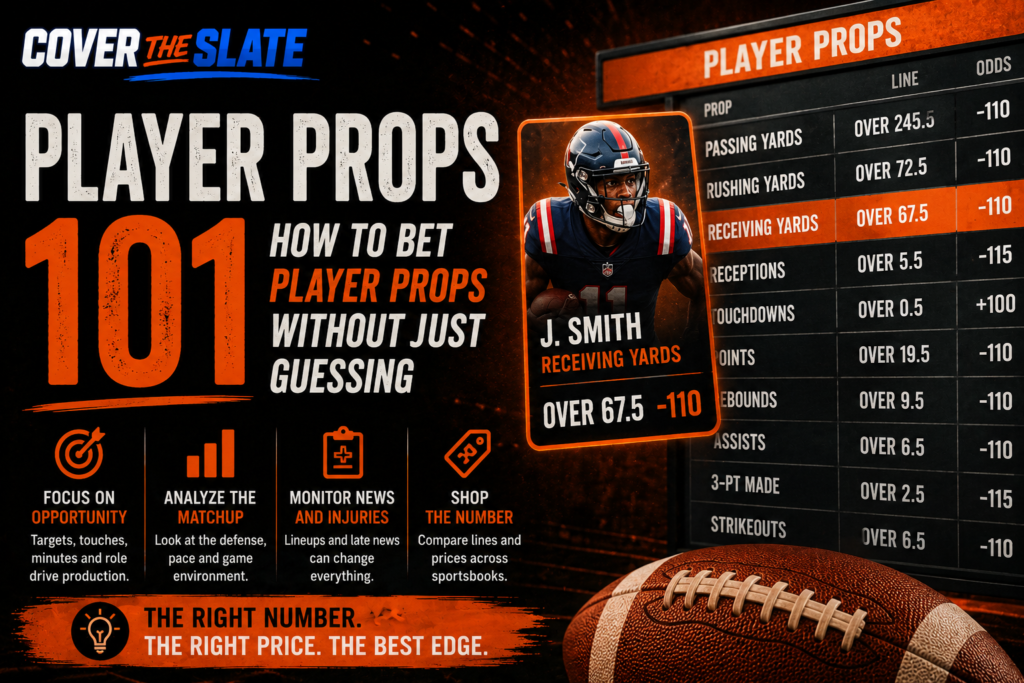
Player props are probably the easiest betting market to understand emotionally.
You watch a receiver all week. You know he gets fed targets. You see his receiving line sitting at 68.5 yards and think:
Yeah. He’s going over that.
That’s the entire seduction.
It also happens to be where a lot of bad prop betting starts.
Because liking a player is not the same thing as liking the number.
A good player can have a bad prop. A mediocre player can have a great one. And a prop that looks obvious at 58.5 might be completely different at 72.5.
If you’re going to bet player props seriously, the job is not to predict whether a player has a good game.
It’s to decide whether the specific line and price are wrong.
What Are Player Props?
A player prop is a wager on an individual player’s performance rather than the final outcome of the game.
Common examples include:
- Passing yards
- Rushing yards
- Receiving yards
- Receptions
- Touchdowns
- Points
- Rebounds
- Assists
- Three-pointers made
- Strikeouts
- Hits
- Shots on goal
- Saves
Most of these are posted as an over/under.
For example:
Wide Receiver Receiving Yards: 67.5
You can bet:
Over 67.5
or
Under 67.5
If he finishes with 82 yards, the over wins.
If he finishes with 54, the under wins.
Very straightforward.
The hard part is figuring out whether 67.5 is a good number.
Start With Opportunity
If I’m evaluating a player prop, the first thing I care about is usually opportunity.
Not highlights.
Not reputation.
Not whether the player scored twice last Sunday.
Opportunity.
For different sports, that can mean different things.
For an NFL receiver:
- Targets
- Route participation
- Snap rate
- Role in the offense
For a running back:
- Carries
- Targets
- Goal-line usage
- Share of backfield work
For an NBA player:
- Minutes
- Usage
- Starting role
- Ball-handling responsibility
For an MLB pitcher:
- Expected pitch count
- Strikeout rate
- Opponent contact profile
- Expected innings
For an NHL player:
- Ice time
- Power-play role
- Shot volume
- Line assignment
You can’t score fantasy points or clear betting props without opportunities to actually do the thing you’re betting.
That sounds obvious.
It’s also one of the easiest things to ignore when the player’s name is familiar.
Volume Usually Matters More Than the Story
Let’s say a receiver has gone over 70 yards in three straight games.
That sounds great.
Now dig one layer deeper.
Maybe he saw:
11 targets
13 targets
12 targets
Now the recent success makes more sense.
But maybe instead he saw:
5 targets
6 targets
4 targets
and happened to break several long plays.
That is a very different profile.
Both players have identical recent box-score results.
Only one may have the kind of underlying opportunity you want to trust going forward.
This is why I’d rather understand how the production happened than simply count how many recent overs hit.
Be Careful With Recent Trends
Sportsbooks know what happened last week.
They also know what happened the week before.
The betting market is not waiting for us to discover that a player has gone over his prop in four straight games.
Recent trends can matter when they reflect a real role change.
Maybe:
- A player became a starter
- Minutes increased
- A teammate got injured
- Usage shifted
- The offense changed
- A lineup move created more opportunity
That’s useful.
But:
“He’s gone over in six of his last seven”
is not enough by itself.
The line may have already moved to account for exactly that.
You need to know whether the current number still leaves room.
The Line Is the Bet
This is the part I want newer bettors to internalize.
Suppose you love a quarterback’s passing matchup.
His prop is:
Over 245.5 yards
You might love it.
Now imagine the exact same quarterback, same game, same everything:
Over 285.5 yards
Still love it?
Probably not nearly as much.
That 40-yard difference is the entire bet.
This is why saying:
“I like the over”
without mentioning the number is incomplete.
You don’t bet a player.
You bet a player at a number and price.
Price Matters Too
The line can stay the same while the odds change.
For example:
Over 67.5 receiving yards -110
Later:
Over 67.5 -125
Same yardage requirement.
More expensive bet.
Or another sportsbook might have:
Over 67.5 -105
Same line.
Better price.
If you’re going to bet props regularly, this is where line shopping can matter a lot.
Different sportsbooks may post different prop numbers or prices.
One has:
67.5 -115
Another has:
65.5 -110
Another has:
67.5 +100
Those are three meaningfully different wagers.
You don’t get extra credit for betting the first one you see.
Matchup Matters, But Don’t Make It the Whole Analysis
Matchup is important.
It’s also probably one of the most abused words in sports betting.
“Great matchup” can mean almost anything depending on the market.
For a receiver, I might care about:
- Coverage tendencies
- Defensive personnel
- Expected game script
- Opponent pass rate allowed
- How the offense uses that receiver
For a pitcher:
- Opponent strikeout tendencies
- Handedness
- Expected lineup
- Ballpark
- Pitch count expectations
For an NBA rebound prop:
- Minutes
- Opponent shot profile
- Pace
- Position
- Team rebounding environment
The mistake is finding one favorable matchup stat and treating it like the case is closed.
Matchup should usually support the argument.
Opportunity should usually lead it.
Injuries Can Change Everything
Props can move fast when injuries hit.
One player being ruled out can change:
- Minutes
- Usage
- Targets
- Carries
- Assists
- Shot attempts
- Rebounds
- Touches
This is why prop betting can be especially sensitive to late news.
Imagine an NBA player averages 28 minutes in his normal role.
Then two rotation players are ruled out and he’s suddenly expected to play 36.
That can completely change the attractiveness of:
- Points
- Rebounds
- Assists
- Made threes
- PRA-style combo markets
But once again:
The sportsbook can adjust too.
The question is whether you’re reacting before the market fully catches up, or simply betting an obvious role change after the line has already been moved.
Game Environment Matters
Props don’t happen in isolation.
An NFL game expected to be fast and competitive can support more offensive plays.
A blowout can reduce fourth-quarter usage for certain stars.
An NBA game with a high expected pace can create more possessions.
A baseball pitcher facing a weak offense may have a better chance to work deep into the game.
A hockey player in a strong offensive environment may see more shot opportunity.
But always connect the game environment to the specific prop.
“High-scoring game” doesn’t automatically mean every player prop over is good.
That’s how sportsbooks fund very nice offices.
Think About How the Prop Can Lose
Most people analyze props from the optimistic side.
Why can this hit?
Useful question.
Now ask:
How does it fail?
Say you’re betting an NFL running back over rushing yards.
Potential failure paths:
- Team falls behind early
- Backfield becomes more split than expected
- Player gets receiving work instead of carries
- Goal-line usage disappears
- Offensive line struggles
- Player gets dinged up
- Game turns pass-heavy
The goal isn’t to scare yourself out of every bet.
It’s to understand the range of outcomes.
A prop with six obvious ways to fail should probably require a more attractive price or number before you get interested.
Overs Are More Fun. That Doesn’t Make Them Better.
This is one of the quieter biases in prop betting.
People like betting overs.
It’s fun to root for things to happen.
More yards.
More points.
More catches.
More strikeouts.
Nobody gathers around the television screaming:
“DON’T CATCH ANOTHER PASS!”
Unless they have the under.
Sportsbooks know bettors generally prefer overs.
That doesn’t mean unders are automatically valuable.
But it does mean you shouldn’t treat the over as the default choice.
Sometimes the better bet is simply that the market has set the line too high.
Usage Changes Are Where Things Get Interesting
The best prop opportunities often come from moments when the player’s role has changed faster than the market’s understanding of that role.
Examples:
A backup running back suddenly inherits most of the touches.
A receiver moves into a bigger role after an injury.
An NBA player starts handling the ball more.
A pitcher’s workload restriction disappears.
An NHL player moves onto the top power-play unit.
That’s more meaningful to me than:
He hit the over last game.
You’re trying to identify new information that changes the player’s expected opportunity.
That’s where prop markets can become interesting.
Don’t Treat Every Stat the Same
Different props have different levels of volatility.
Receptions can behave differently from receiving yards.
Passing attempts can behave differently from passing touchdowns.
NBA minutes can be more predictable than shooting efficiency.
Strikeouts depend on different factors than pitcher wins.
This matters because two props on the same player may have very different levels of uncertainty.
Maybe you like a receiver’s target volume but don’t love his yardage efficiency.
Receptions could be more attractive than receiving yards.
Maybe you expect a quarterback to throw often but don’t have a strong opinion on whether those throws produce touchdowns.
Passing attempts might better express the idea than passing touchdowns.
The best prop is the one that most directly matches the thing you believe the market is mispricing.
A Simple Prop Evaluation Example
Let’s say a receiver has a line of:
Over 5.5 receptions
Before betting it, I’d want to know:
Role: Is he running routes consistently?
Targets: How often is the quarterback looking his way?
Target quality: Are they short, catchable targets or lower-percentage deep shots?
Game environment: Is his team likely to throw?
Competition: Are teammates returning who could reduce volume?
Matchup: Does the defense influence where targets tend to go?
Recent changes: Has his role actually changed?
Price: Are we laying -110, -125 or something worse?
Other books: Is 5.5 the best number available?
That’s the analysis.
Not:
He had eight catches last week.
Same-Game Parlays Change the Equation
Player props naturally end up in same-game parlays because they can be correlated.
For example:
Quarterback over passing yards
and
Wide receiver over receiving yards
Those outcomes can work together.
But correlation doesn’t mean the bet is automatically good.
You still need to understand:
- The price
- The individual legs
- How the sportsbook accounts for correlation
- Whether you’re actually getting fair compensation for the combined probability
Same-game parlays deserve their own article because they can get complicated quickly.
For now, just understand that combining several props into one bet changes the math.
It doesn’t simply create a more exciting version of the same wager.
The Cover The Slate Prop Process
If I’m breaking down a prop, I want to answer these questions:
What is the player’s expected role?
What opportunity should that role produce?
Has anything changed?
What does the matchup actually affect?
What game environment are we expecting?
What number is being offered?
What price comes with it?
Can I get a better number somewhere else?
If we can’t answer most of those, we probably don’t have much of a case.
And sometimes the answer after all that research is:
Pass.
That is allowed.
Sportsbooks will still be there tomorrow.
The Point of Player Props
Player props are fun because they let you get extremely specific.
You don’t need to decide which team wins.
You can have an opinion about one player, one role and one number.
That makes them approachable.
It also makes them easy to oversimplify.
The best prop analysis usually isn’t:
This guy is good.
It’s:
His opportunity, role and game environment make this specific number look wrong.
That’s the difference between betting a player you like and actually betting the prop.