
MLB DFS Picks: DraftKings 10-Game Main Slate for September 15
DraftKings MLB DFS picks for the September 15, 2026 main slate: Logan Gilbert, Padres power, Mariners value and Cardinals stacks for the 7:07 p.m. ET start.
 By
By 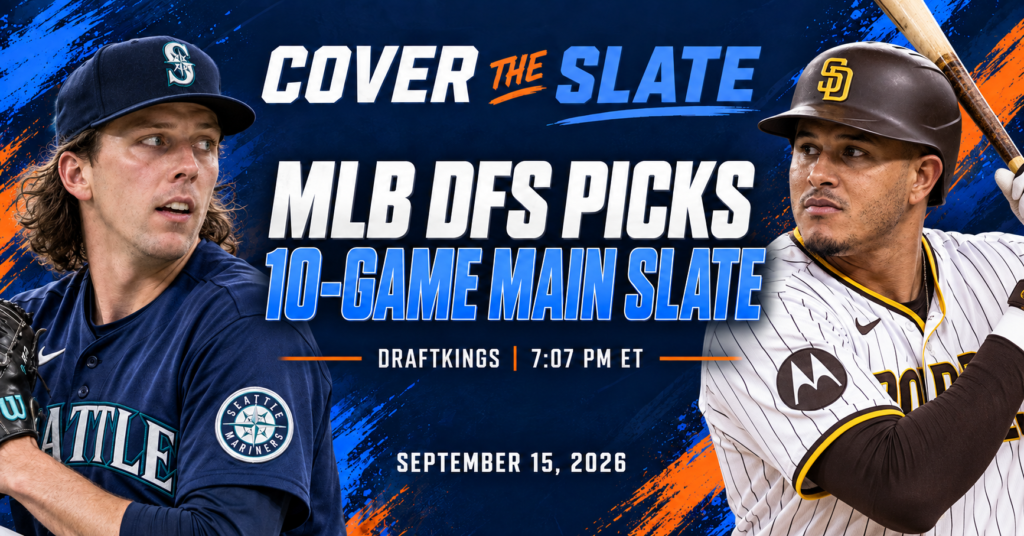
Our MLB DFS picks for Tuesday, September 15, 2026 start with Logan Gilbert on the mound, San Diego as the premium stack and Seattle as our favorite way to balance pitching with a full offense. The DraftKings 10-game main slate begins at 7:07 p.m. ET with Detroit at Toronto. St. Louis is our tournament alternative when the expensive Padres make the rest of a lineup too thin.
- MLB DFS picks today: the quick board
- September 15 DraftKings main slate: games and start times
- Best DraftKings MLB pitchers
- Logan Gilbert: pay for strikeouts, not perfection
- Max Fried: a stronger run-prevention profile at a higher cost
- Sean Manaea: useful savings with a real failure case
- Best MLB DFS stacks for September 15
- 1. San Diego Padres: premium offense, expensive construction
- 2. Seattle Mariners: our favorite balanced stack
- 3. St. Louis Cardinals: the salary-efficient tournament alternative
- DraftKings value bats: who actually helps the build?
- Lineup construction: two workable salary paths
- Ownership, weather and the final decision
- September 15 MLB DFS FAQ
The key decision is not simply whether you like Coors Field. It is how much pitching and lineup depth you are willing to sacrifice to pay for it. Fernando Tatis Jr. and Manny Machado take a substantial bite out of the budget. There are workable builds around them, but there is also a strong case for getting your offense elsewhere.
Batting orders referenced below are projected, not confirmed. Hitter recommendations assume a starting role.
MLB DFS picks today: the quick board
- Favorite pitcher: Logan Gilbert, Seattle.
- More expensive SP2: Max Fried, New York Yankees.
- Volatile salary-saving SP2: Sean Manaea, New York Mets.
- Premium stack: San Diego, with the right-handed bats first.
- Favorite balanced stack: Seattle.
- Tournament alternative: St. Louis.
- Construction: Preserve two credible pitchers. Use a smaller Padres stack if five expensive bats force too many weak concessions.
September 15 DraftKings main slate: games and start times
| Matchup | Start |
|---|---|
| Detroit Tigers at Toronto Blue Jays | 7:07 p.m. |
| Baltimore Orioles at New York Mets | 7:10 p.m. |
| Atlanta Braves at Chicago Cubs | 7:40 p.m. |
| New York Yankees at Minnesota Twins | 7:40 p.m. |
| San Francisco Giants at St. Louis Cardinals | 7:45 p.m. |
| Boston Red Sox at Texas Rangers | 8:05 p.m. |
| Kansas City Royals at Houston Astros | 8:10 p.m. |
| San Diego Padres at Colorado Rockies | 8:40 p.m. |
| Seattle Mariners at Los Angeles Angels | 9:38 p.m. |
| Miami Marlins at Arizona Diamondbacks | 9:40 p.m. |
The earlier games are outside this main slate. That keeps attractive early-window pitchers from becoming accidental recommendations for the wrong contest. Matchups and times are available on the official MLB probable-pitcher board.
Best DraftKings MLB pitchers
| Pitcher | Opponent | DK salary | CTS role |
|---|---|---|---|
| Logan Gilbert | at LAA | $10,000 | Preferred SP1 |
| Max Fried | at MIN | $9,000 | Run-prevention alternative |
| Sean Manaea | vs. BAL | $7,500 | Riskier SP2 savings |
Salary references: DraftKings Network’s Tuesday slate and the September 15 DraftKings salary listings.
Logan Gilbert: pay for strikeouts, not perfection
Gilbert has 187 strikeouts in 172 innings, with a 3.72 ERA and 3.84 FIP. He has also allowed 27 home runs, so this is not an argument that nothing can go wrong. It is an argument for buying a substantial strikeout workload in a favorable matchup. FanGraphs pitching statistics.
DraftKings Network identifies the Angels as one of baseball’s highest-strikeout offenses. That combination makes Gilbert our first pitching click. I would rather find a reasonably priced secondary stack than automatically remove him to squeeze in one more premium hitter.
How we use him: Lead the pitching pool with Gilbert. Pair him with Fried when the bats cooperate, or accept Manaea’s volatility when the offensive upgrade is meaningful.
Max Fried: a stronger run-prevention profile at a higher cost
Fried brings a 2.73 ERA through 99 innings and 8.5 strikeouts per nine innings into Minnesota. Those are meaningful run-prevention results, although his strikeout pace does not automatically make him the best ceiling play at any price. Yankees-Twins matchup statistics.
The Gilbert-Fried pairing is our preferred starting point when a Seattle or Cardinals stack leaves enough room. Its opportunity cost is straightforward: a second expensive pitcher reduces what you can spend on hitting. Do not force the pair if it turns several batting slots into players you would otherwise avoid.
Sean Manaea: useful savings with a real failure case
Manaea’s appeal is matchup-driven. His season strikeout rate is 21.6%, and Baltimore has the highest strikeout rate against left-handed pitching in DraftKings Network’s matchup breakdown. The warning is equally important: he has surrendered at least four earned runs in five consecutive starts. Manaea’s matchup and recent results.
This is our salary-saving tournament choice, not a safe play disguised as value. The upside path is enough strikeouts to support a productive outing while the saved salary improves the stack. The failure path is another short, damaging start. Use him because you want the entire lineup that his price creates, not simply because he is cheaper.
Best MLB DFS stacks for September 15
The stack pools below list DraftKings salaries, not defensive-position assignments. RotoWire’s main-slate lineup and salary display supplies the expected-lineup context and listed hitter prices.
1. San Diego Padres: premium offense, expensive construction
San Diego faces left-hander Kyle Freeland at Coors Field. His 6.37 ERA adds a vulnerable opposing starter to the park appeal. Our preference is to start with the right-handed bats rather than treating every Padre as an equally strong individual play.
| Hitter | DK salary | Priority within our stack |
|---|---|---|
| Fernando Tatis Jr. | $7,000 | Premium right-handed anchor |
| Manny Machado | $6,200 | Core right-handed bat |
| Luis Campusano | $4,200 | More accessible right-handed piece |
| Xander Bogaerts | $5,000 | Fourth right-handed option |
| Jake Cronenworth | $4,200 | Left-handed stack extension |
Our approach: Campusano helps connect the expensive stars to the rest of the roster. Cronenworth is more appealing as part of a correlated offense than as a left-on-left one-off. A four-man stack is entirely reasonable here. The park does not obligate us to buy five Padres.
What makes this bad chalk: Paying for the obvious offense and then filling several other slots solely on price. A strong team environment cannot rescue a poorly constructed entire lineup. We expect San Diego to attract attention, but that is an ownership inference, not a measured roster percentage.
2. Seattle Mariners: our favorite balanced stack
Seattle gets right-hander Ryan Johnson, who carries a 5.12 ERA. More importantly for construction, this offense gives us multiple useful price points instead of requiring a collection of premium salaries.
| Hitter | DK salary | CTS use |
|---|---|---|
| J.P. Crawford | $3,000 | Lower-cost stack entry |
| Randy Arozarena | $5,600 | Power-speed centerpiece |
| Dominic Canzone | $3,800 | Left-handed correlation |
| Josh Naylor | $3,500 | Midrange left-handed piece |
| Cole Young | $3,100 | Salary-conscious fifth hitter |
Arozarena’s 25 home runs and 22 stolen bases give this group an established power-speed anchor. Arozarena’s season production.
Our approach: This is the stack I prefer when keeping both stronger pitchers matters. It can score through a sequence of hits and runs rather than requiring every inexpensive hitter to homer. Crawford, Canzone and Naylor are useful budget pieces inside that connected offense, not just unrelated cheap names.
3. St. Louis Cardinals: the salary-efficient tournament alternative
St. Louis faces right-hander Blade Tidwell. Our angle is the combination of a different game environment and a stack that does not consume most of the hitter budget. This is a construction pivot away from San Diego, not a claim that the Cardinals have the higher raw scoring expectation.
| Hitter | DK salary | CTS use |
|---|---|---|
| Bryan Torres | $3,400 | Affordable stack connector |
| Alec Burleson | $4,900 | Primary spending priority |
| Leo Bernal | $3,500 | Mid-priced stack piece |
| Nolan Gorman | $2,700 | Lower-cost extension |
| Nathan Church | $2,800 | Budget fifth hitter |
Our approach: Spend deliberately on Burleson and use the cheaper pieces to keep the lineup connected. Church makes more sense in a full team bet than as a compulsory one-off. The ceiling case is a sustained Cardinals rally that pays several roster spots at once. Being different by itself is not enough.
DraftKings value bats: who actually helps the build?
The best value is the player who improves the entire roster, not necessarily the lowest salary in the pool.
- Crawford: Our preferred inexpensive entry to a Seattle stack. His value is stronger when paired with the offense around him.
- Gorman: A budget-friendly Cardinals extension that lets us allocate more money to pitching.
- Bernal: A way to include the catcher slot in a Cardinals stack instead of treating it as an unrelated afterthought.
- Campusano: Not a basement-priced punt, but a more manageable route into the Padres than another premium bat.
We are intentionally not building around a speculative bench bat. Cheap salary without a starting role is not useful value.
Lineup construction: two workable salary paths
Balanced tournament framework
Gilbert + Fried cost $19,000. The five Mariners in our table total $19,000. Together, that leaves $12,000 for three hitters, or $4,000 per slot. That is why Seattle stands out: we can maintain our preferred pitching structure without requiring three extreme punts.
The five listed Cardinals total $17,300. With the same pitchers, that leaves $13,700 for three hitters. The extra room can strengthen the secondary offense rather than being spent automatically.
Premium Padres framework
Gilbert + Manaea cost $17,500. Tatis, Machado, Campusano and Bogaerts total $22,400. That leaves $10,100 for four hitters. It is a much tighter build, and the remaining players must justify their places. This is the practical reason to consider four Padres instead of forcing a fifth.
These are salary frameworks, not complete lineups or projections. DraftKings position eligibility must fit the remaining roster slots. Do not use opposing hitters against your own pitcher simply to complete a stack.
Ownership, weather and the final decision
Ownership: We do not have a verified numerical ownership feed for this article. Treat San Diego as a likely popular construction and Seattle or St. Louis as alternatives, not as guaranteed low-owned teams. Different stack combinations and a credible pitching decision are more useful than a random low-owned name.
Weather: Chicago, St. Louis and Denver are outdoor environments on this slate. A rain percentage alone does not establish a postponement or a safe pitching workload. A meaningful interruption risk would reduce our interest in affected pitchers; a weather-related stack change should preserve both salary and positional flexibility. This article is not an all-clear weather declaration.
Our lean: Start with Gilbert. Prefer the balanced Seattle construction when it preserves Fried, use St. Louis for a different tournament path, and buy San Diego’s right-handed core when the remaining roster still makes sense. Manaea is the calculated risk that unlocks more hitting, not an automatic second pitcher.
September 15 MLB DFS FAQ
What time does the DraftKings MLB main slate start?
The September 15, 2026 main slate starts at 7:07 p.m. ET and contains 10 games.
Who is our favorite MLB DFS pitcher tonight?
Logan Gilbert is our preferred SP1. Max Fried is the more expensive pairing option, while Sean Manaea offers savings with substantially more recent-form risk.
Do you need five Padres to play this slate?
No. Four Padres can preserve a premium core, while Seattle and St. Louis offer more room for pitching and a useful secondary stack.
Find more free picks and analysis in our MLB DFS section.