
What Is Closing Line Value? Why the Number You Bet Matters
Winning tells you what happened. Closing line value can tell you more about the price you actually bet. Here’s what CLV means and why bettors track it.
 By
By 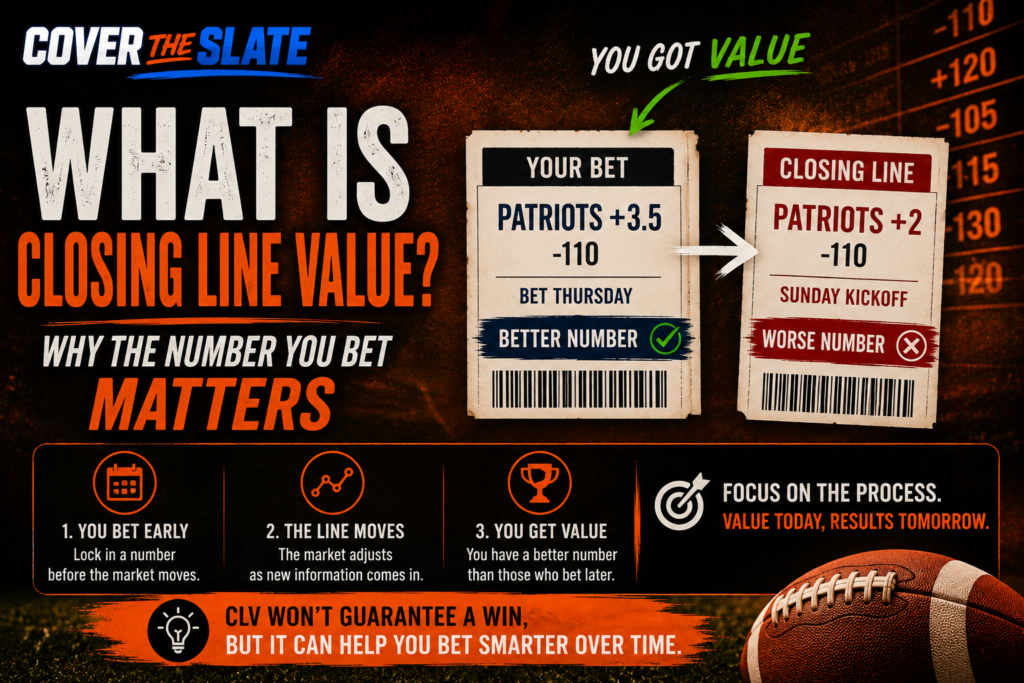
Closing line value is one of the better ways to answer a question sports bettors are notoriously bad at answering:
Was that actually a good bet?
Not whether it won.
Whether it was good.
Let’s say it’s Thursday afternoon and you bet the Patriots +3.5 against Buffalo.
Sunday rolls around. The market has moved.
Patriots +2.
You have +3.5 sitting on your bet slip while anyone betting the Patriots now gets +2.
Then Buffalo wins by 3.
Your bet cashes. The guy who waited until Sunday loses.
Same game. Same team. Same final score.
You just owned a much better bet.
Welcome to closing line value.
What Is Closing Line Value?
Closing line value, usually shortened to CLV, compares the price or line you bet to the market’s closing price.
The closing line is generally the final widely available market price immediately before an event begins.
If you consistently get better numbers than the closing market, you’re said to be beating the closing line.
A few simple examples:
You bet +3.5 → closes +2
You beat the closing line.
You bet -2 → closes -3.5
You beat the closing line.
You bet +140 → closes +115
You beat the closing price.
You bet -110 → closes -135
You beat the closing price.
In each case, you secured a wager at terms that were no longer available by game time.
That’s valuable.
Literally.
Why Closing Line Value Matters
Go back to our Patriots example.
You have:
Patriots +3.5
The market eventually settles around:
Patriots +2
The sportsbook isn’t going to come back Sunday morning and say:
“Hey, we changed our minds. Please give us that extra point and a half back.”
Your ticket is your ticket.
You’ve effectively purchased something before its market price changed.
Think about it like buying a concert ticket for $100 and watching the same seats sell for $150 a few days later.
You still haven’t seen the concert. Maybe the band is terrible. Maybe the lead singer gets food poisoning halfway through the second song.
But you can still say you bought the ticket at a better price.
That’s essentially what CLV is trying to measure.
The Closing Line Is a Benchmark, Not a Crystal Ball
This distinction matters.
People sometimes talk about closing lines as if sportsbooks receive the final score from the future and politely hide it until kickoff.
They don’t.
The closing market can be wrong.
Favorites lose. Underdogs get destroyed. Games sail over totals the market spent all week betting down.
Closing lines are useful because mature betting markets can incorporate enormous amounts of information over time: injuries, weather, lineup changes, limits, bettor activity and new information entering the market.
That makes the closing price a useful benchmark.
It does not make it infallible.
You Can Beat the Closing Line and Still Lose
This is where CLV connects directly to expected value.
Suppose you bet:
Over 47.5
By kickoff:
Over 50.5
Great.
Then the game ends 17-13.
You lost.
Did the fact that the total finished at 30 suddenly erase the value of having 47.5 instead of 50.5?
No.
You would rather have Over 47.5.
Every single time.
This sounds obvious when the numbers are sitting next to each other. It becomes considerably less obvious when you’ve just watched both quarterbacks spend three hours punting.
The result and the quality of the number are different things.
You Can Also Win With Terrible CLV
Now flip it.
You bet:
Over 50.5
The market closes:
47.5
Not ideal.
Then the teams combine for 72 points and your bet wins before the fourth quarter.
Your account balance does not care.
Green is green.
But if you’re evaluating your betting process, you should care.
The market moved three points against the number you took.
Maybe you had information or analysis the market didn’t appreciate. That’s possible.
Maybe you just paid too much.
One game can’t answer that question.
Repeatedly getting worse numbers than the closing market is something worth investigating.
Spread CLV Is Easy to See
Point spreads make CLV pretty intuitive.
If you bet an underdog at +7 and the game closes +5.5, you have an extra 1.5 points.
If you bet a favorite -2.5 and it closes -4, same idea.
Those points can directly determine whether your bet wins, pushes or loses.
Consider a game that ends:
Favorite 24, Underdog 21
A bettor holding:
Favorite -2.5 wins.
A bettor holding:
Favorite -4 loses.
The difference between those tickets had nothing to do with predicting the final score differently.
It was the number.
Moneyline CLV Looks Different
Moneylines don’t have points attached, so you’re comparing prices instead.
Suppose you bet an underdog:
+160
The market closes:
+130
If you win a $100 wager at +160, your profit is $160.
Someone making the same $100 wager at +130 wins $130.
You both picked the same winner.
You got paid more.
Favorites work similarly.
Getting -130 instead of -150 means risking less money for the same potential profit.
This is why odds shopping isn’t some obsessive side hobby for people who enjoy refreshing sportsbook apps.
Price matters.
Is Beating the Closing Line Proof You’re a Winning Bettor?
No.
And this is where we need to be careful.
You will sometimes hear a version of:
“If you’re consistently beating the closing line, you’re guaranteed to win long term.”
That’s stronger than the evidence allows.
Consistent CLV can be a useful signal that you’re finding favorable prices, particularly in liquid and efficient markets.
But there are complications.
Which sportsbook’s closing line are we using?
How efficient is the market?
How much liquidity does it have?
Did the line move because of meaningful new information?
Are we comparing the same exact market and rules?
A major NFL spread shortly before kickoff and an obscure player prop with a tiny betting limit are not necessarily equally informative benchmarks.
Context matters.
CLV is a tool.
Not a certificate declaring you Sports Betting Einstein.
One Great Closing Number Doesn’t Mean Much Either
You bet +4.
It closes +2.
Congratulations.
Do it again.
One example of positive CLV tells us almost nothing about whether you have an actual edge.
Maybe you anticipated the market beautifully.
Maybe news broke five minutes after your bet.
Maybe a major bettor moved the market.
Maybe you got lucky.
The interesting question is what happens across a meaningful sample of wagers.
Are you consistently getting better prices than the close?
That’s much more useful.
How to Track Closing Line Value
You don’t need anything elaborate.
When you record a bet, track at least:
The market you bet
Your line or odds
The closing line or odds
Your result
For example:
Bet: Eagles -2.5 (-110)
Close: Eagles -3.5 (-110)
Result: Loss
The loss still goes in the loss column.
But now you have another piece of information about the decision itself.
Over time, you can look for patterns.
Maybe you’re consistently beating NFL sides but getting awful numbers on NBA totals.
Maybe bets made Tuesday are beating the close while your Sunday morning bets aren’t.
Maybe one sportsbook routinely gives you a better number in a particular market.
That’s useful information.
“I’m 8-2 this week” is fun.
This is analysis.
CLV Makes Line Shopping Make Sense
Once you understand closing line value, line shopping stops feeling like advice invented by people trying to make betting more complicated.
Suppose three sportsbooks offer:
Book A: +125
Book B: +130
Book C: +140
Same team.
Same market.
Same moment.
Assuming the wagers are otherwise equivalent, why would you voluntarily take +125?
You wouldn’t walk into three gas stations selling the same gallon of gas for $3.20, $3.30 and $3.50 and proudly choose $3.50 because you “really like the gas.”
Price shopping is normal everywhere else.
It should be normal here too.
Stop Asking Only Whether You Won
Wins matter.
We’re not going to become so enlightened that we start celebrating losing tickets because they had wonderful CLV.
The objective is still to make money.
But individual results are noisy.
You can make a smart bet and lose.
You can make a stupid bet and win.
Sometimes you can make a stupid bet, win, screenshot it, post it to X and spend the next six months believing you’ve solved sports betting.
Closing line value gives you another way to evaluate what you’re doing.
Did you get a good number?
Did the market move toward your position?
Are you consistently finding prices that disappear later?
Those questions won’t tell you everything.
But they’re considerably more useful than staring at yesterday’s record and deciding you’re either a genius or an idiot.
The final score tells you whether your bet won.
The number you got tells you something about the bet you made.
Pay attention to both.