
What Is Expected Value (EV) in Sports Betting? Why Winning Bets Aren’t Always Good Bets
Winning and losing don’t tell you whether a wager was actually good. Expected value explains how price, probability and long-term results fit together in sports betting.
 By
By 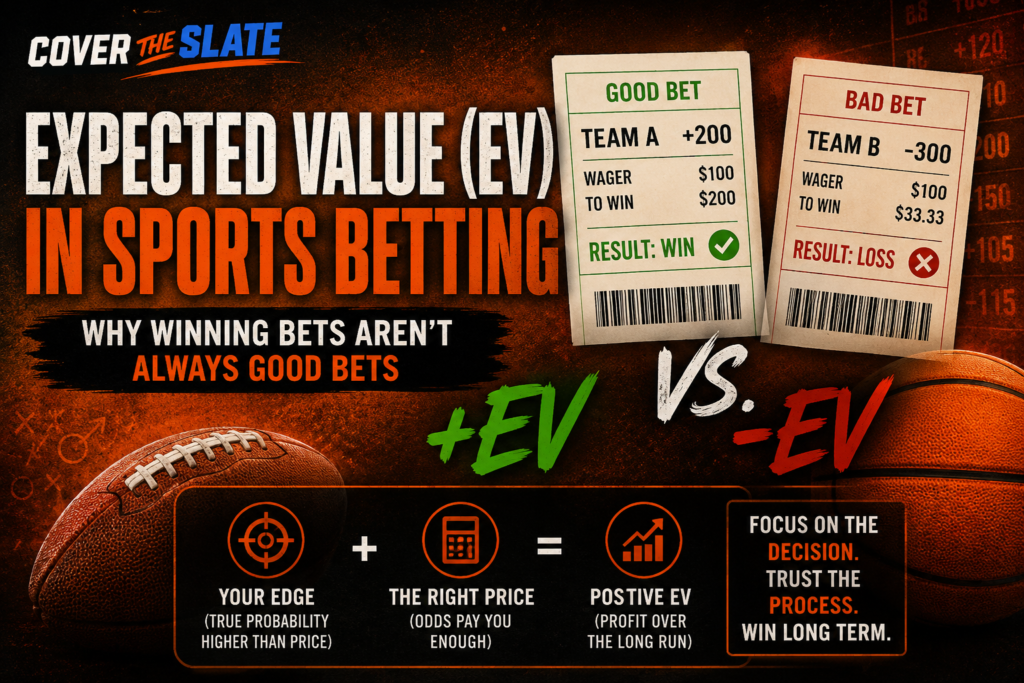
Expected value in sports betting is one of those concepts that sounds like it requires a finance degree until you realize you already understand it.
Imagine I offer you a coin flip.
Heads, I give you $150.
Tails, you give me $100.
Would you play?
Of course you would. You won’t win every flip. You might lose the first three and briefly wonder why you trusted a sports website with your money.
But you’d still want to keep playing.
Why?
Because the deal is in your favor.
That, more or less, is expected value.
The Result and the Decision Are Two Different Things
This might be the single most important mental adjustment a bettor can make.
You bet an NFL underdog at +200.
They win.
Was it a good bet?
Maybe.
You bet another team at -110.
They lose on a 61-yard field goal as time expires.
Was it a bad bet?
Maybe.
The final score doesn’t answer either question.
Betting has a nasty habit of giving immediate feedback on decisions that should really be judged over hundreds of repetitions.
Make a terrible bet and win? Your account balance congratulates you.
Make a great bet and lose? Your account balance calls you an idiot.
Neither is particularly helpful.
The goal isn’t to figure out whether this bet won.
It’s to figure out whether you’d want to make this type of bet at this price repeatedly.
So What Exactly Is Expected Value?
Expected value, usually shortened to EV, is the average amount you would expect to win or lose if you could make the same wager over and over again under identical conditions.
Positive expected value is written as +EV.
Negative expected value is -EV.
If a wager is +EV, the theoretical return is positive over enough repetitions.
If it’s -EV, the theoretical return is negative.
Obviously, sports don’t let us replay Bills-Dolphins 10,000 times with identical weather, injuries, lineups and circumstances.
That’s why EV in sports betting isn’t something we can simply observe beforehand.
We have to estimate probability.
And that’s where things get difficult.
A Simple +EV Example
Let’s go back to our coin.
It’s a fair coin, so:
Heads: 50% probability
Tails: 50% probability
But I’m offering you:
Risk $100 to win $150 on heads.
Across 100 theoretical flips:
You’d expect roughly 50 wins.
50 × $150 = $7,500 profit
And roughly 50 losses.
50 × $100 = $5,000 lost
Your theoretical net:
+$2,500
Divide that across 100 wagers and the expected value is:
+$25 per $100 bet.
That’s an absurdly favorable wager.
You’d still lose approximately half the individual flips. But losing individual flips doesn’t make the opportunity bad.
The edge comes from being paid more than the underlying probability warrants.
Sports betting works on the same basic principle.
Finding that probability is just considerably harder than identifying the two sides of a quarter.
Price Changes Everything
Suppose you believe a team has a 50% chance of winning.
A sportsbook offers:
Team A +150
If your 50% estimate is accurate, that’s potentially a very attractive price.
Now suppose the exact same team in the exact same game is offered at:
Team A -150
Still interested?
Probably not.
Nothing changed about the team.
Nothing changed about your prediction.
The price changed.
This is why “Who do you like tonight?” isn’t really a complete betting question.
I might love a team at +140.
I might think they’re fairly priced at +110.
I might want absolutely nothing to do with them at -130.
Same team. Same game. Different bet.
The Hard Part: You Don’t Know the True Probability
This is where EV gets abused.
You’ll occasionally see somebody declare:
“This bet is +EV.”
Okay.
According to what?
Expected value calculations require some estimate of the true probability of an outcome. In a coin flip, we know that probability.
In Celtics-Knicks?
Good luck.
You can use models, projections, historical data, injury information, market prices and plenty of other inputs to estimate probability.
But it remains an estimate.
If you think an outcome happens 60% of the time and reality is closer to 48%, your beautiful +EV calculation isn’t actually +EV.
Your input was wrong.
That’s why Cover The Slate won’t present an estimated edge as some kind of objective law of physics.
When we’re confident that a price looks favorable, we’ll explain why.
When the edge depends heavily on assumptions, we’ll tell you that too.
Fake precision doesn’t make analysis smarter.
How Odds Connect to EV
American odds aren’t just payout numbers. They imply a probability.
For example, odds of -110 correspond to an implied probability of roughly 52.4% before getting into the broader market and sportsbook margin.
That’s useful because now we have something to compare.
If your analysis suggests an outcome should occur 55% of the time and you’re being offered -110, you may have an edge.
If you estimate it at 49%, you don’t.
This is the basic hunt:
What probability is the market pricing?
versus
What probability do I believe is more accurate?
The gap between those two numbers is where potential value lives.
The enormous caveat is worth repeating:
Your probability estimate can be wrong.
Often spectacularly wrong.
Why Sportsbooks Usually Have the Advantage
Sportsbooks don’t generally offer perfectly fair odds.
They build margin into their markets, commonly referred to as the vig or juice.
A classic example is a point spread with both sides priced at -110.
You risk $110 to win $100.
If two sides of an outcome were truly 50/50 and there were no sportsbook margin, fair pricing would look different.
That extra cost matters.
It means a bettor can’t simply be right half the time on standard -110 wagers and expect to break even over the long run.
At -110, the break-even win rate is approximately 52.38%.
Win less frequently than that over a sufficiently large sample and you’re losing money.
Again, this is why picking winners isn’t enough.
You need to beat the price.
A Losing Bet Can Be a Good Bet
Let’s make this uncomfortable.
You bet an underdog at +200.
Based on your analysis, you believe its actual probability of winning is substantially better than the roughly one-third probability implied by +200 odds.
The game starts.
Your team gets smoked.
27-6.
Never competitive.
Was your bet wrong?
The temptation is to say yes because you just watched three hours of evidence suggesting you are an idiot.
But one result doesn’t prove that.
If your probability estimate was sound and the offered price was favorable, the bet could still have been good.
Sometimes the 35% outcome loses.
In fact, we’d expect it to lose most of the time.
That’s not a contradiction.
That’s probability.
And a Winning Bet Can Be Terrible
The reverse is more dangerous because winning feels fantastic.
Say you routinely bet huge favorites at awful prices simply because you’re convinced they’re going to win.
They often do.
Your betting history fills up with green checkmarks.
Then eventually one loses and wipes out the profit from several winners.
The problem wasn’t necessarily that one favorite lost.
The problem may have been that you consistently paid too much for the probability you were buying.
Winning can hide bad process.
That’s one reason evaluating betting performance purely by recent wins and losses can be so misleading.
This Is Also Why Parlays Are So Seductive
Parlays put giant potential payouts directly in front of you.
Bet $10.
Win $240.
That feels a hell of a lot more exciting than risking $11 to win $10.
But payout size tells you nothing by itself about expected value.
The question is whether the payout adequately compensates you for the probability of every leg winning.
Sometimes a promotion or unusual pricing can change the calculation.
But “this could turn $10 into $240” is not analysis.
It’s an advertisement.
We’ll get deeper into parlays separately.
They deserve their own intervention.
You Don’t Need to Calculate EV Before Every Bet
This is important.
If you’re betting recreationally, nobody is asking you to open Excel before taking the Patriots +3.
Understanding EV is more valuable than obsessively calculating it.
It changes the questions you ask.
Instead of:
Who is going to win?
You start asking:
What probability does this price imply?
Do I think the true probability is higher or lower?
Am I getting a good number?
Would I make this bet repeatedly at this price?
Now you’re thinking about betting differently.
Stop Judging Yourself One Bet at a Time
There will be bets you research carefully that lose immediately.
There will also be bets you probably shouldn’t have made that somehow cash.
Sports provide enough randomness to make both inevitable.
So don’t let one result rewrite the entire story.
Evaluate the reasoning.
Evaluate the number you got.
Evaluate whether your assumptions made sense.
Track what happens over time.
The objective isn’t to never lose a bet. That’s impossible.
The objective is to consistently put yourself on the side where the potential reward is worth more than the risk you’re taking.
That’s expected value.
And once you understand it, sports betting stops being quite so much about predicting tonight’s winner.
It becomes a game of price, probability and finding mistakes.