
Sports Betting Odds Explained: How to Read American Odds
Sports betting odds tell you more than who is favored. Learn how American odds work, what plus and minus odds mean, how payouts are calculated and why the price of a bet matters.
 By
By 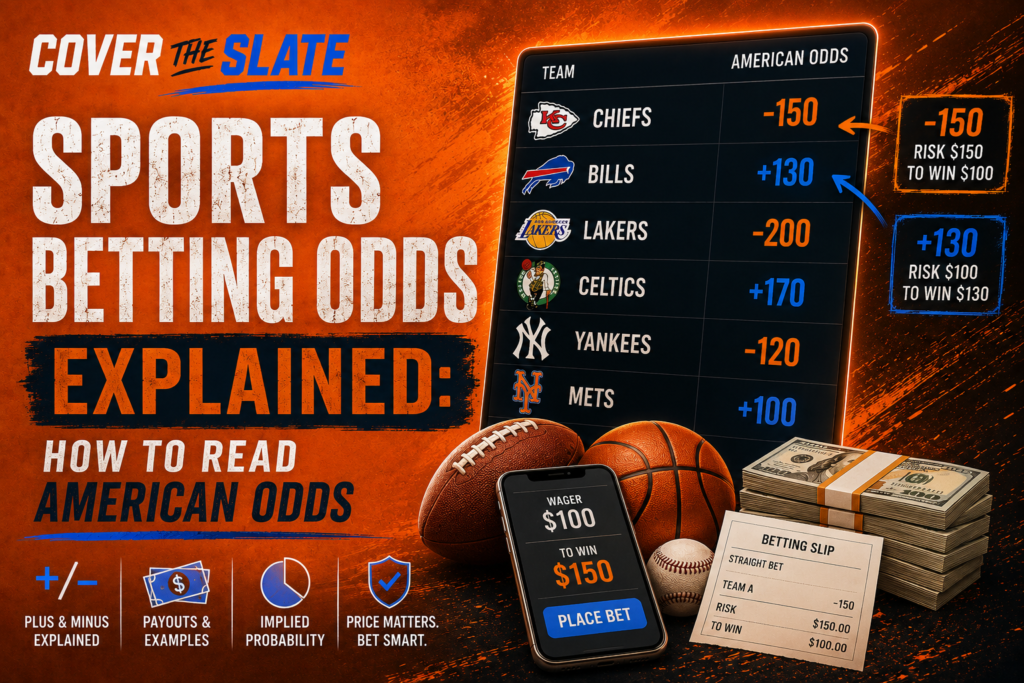
Sports betting odds look more complicated than they actually are.
You open a sportsbook and see:
Chiefs -150
Bills +130
Cool. One team has a minus sign, the other has a plus sign, and somehow this tells you who is favored, how much you’ll win and roughly how likely the sportsbook thinks each outcome is.
If you’re new to betting, that can feel like somebody handed you a calculator without telling you what any of the buttons do.
The good news: American odds are pretty easy once you understand what the numbers are actually telling you.
Let’s start there.
What Are American Betting Odds?
American odds are the + and – numbers you see next to bets at U.S. sportsbooks.
For example:
Team A -150
Team B +130
Those odds communicate two important things:
- The potential payout of the bet
- The probability being reflected by the price
The minus sign generally identifies the favorite.
The plus sign generally identifies the underdog.
But don’t stop there.
The actual number matters just as much as the sign.
What Do Negative Odds Mean?
Let’s start with:
-150
With negative American odds, the number tells you how much you would need to wager to make $100 in profit.
At -150:
Bet $150 → Profit $100
If the bet wins, you’d receive $250 back in total:
- Your original $150 stake
- $100 profit
You absolutely do not need to bet $150.
That’s just the ratio the odds represent.
A $15 bet at -150 would profit $10.
A $30 bet would profit $20.
The sportsbook handles the math for you.
The important part is understanding what the price means.
What Do Positive Odds Mean?
Now let’s look at:
+150
Positive odds tell you how much profit you’d make from a $100 wager.
At +150:
Bet $100 → Profit $150
Your total return would be $250:
- Your original $100
- $150 profit
Again, you don’t need to bet $100.
Bet $10 at +150 and your profit would be $15.
The ratio stays the same.
The Easiest Way to Remember American Odds
If you’re staring at the screen trying to remember which number means what, use this:
Minus odds: How much you’d need to bet to profit $100.
Plus odds: How much you’d profit on a $100 bet.
That’s basically the entire language.
-200: Risk $200 to profit $100.
+200: Risk $100 to profit $200.
Once that clicks, American odds become much easier to read.
Bigger Favorites Have More Negative Odds
Here’s where you can start reading a betting board quickly.
Compare:
-110
-150
-250
-500
As the number gets further below zero, the implied likelihood of that outcome increases.
A -500 favorite is being priced as much more likely to win than a -150 favorite.
The tradeoff?
Your potential return gets smaller relative to the amount you’re risking.
That’s why blindly betting enormous favorites isn’t some magical infinite-money loophole.
You win less when you’re right, and the occasional loss hurts a lot more.
Bigger Underdogs Have More Positive Odds
The same idea works in the opposite direction.
Compare:
+110
+175
+300
+600
As the positive number increases, the implied probability of that outcome decreases.
But the potential payout increases.
That’s the fundamental tradeoff of betting odds.
Higher probability = lower potential return.
Lower probability = higher potential return.
The sportsbook isn’t giving you extra money because it likes you.
You’re being paid more because the outcome is considered less likely.
Why Are So Many Bets -110?
If you’ve bet point spreads or totals, you’ve probably seen this:
Team A -3.5 (-110)
or:
Over 47.5 (-110)
Why -110 instead of +100?
Because the sportsbook needs a way to make money.
That extra amount built into the price is commonly called the vig, juice or hold, depending on exactly what you’re describing.
Consider a simplified market where both sides are priced at -110.
You bet $110 on one side.
Someone else bets $110 on the other.
The sportsbook has collected $220.
One side wins and receives $210 back: the original $110 stake plus $100 in profit.
The sportsbook keeps the remaining $10.
Real sportsbook economics are more complicated than that simple example, but it shows why the price matters.
You’re not just trying to pick winners.
You have to beat the price too.
Winning 50% of Your Bets Isn’t Necessarily Enough
This is one of the first major lessons every bettor should understand.
If you consistently bet markets priced at -110 and win exactly half your bets, you’ll lose money over time.
Why?
Because your losses cost slightly more than your wins make.
Suppose you make two $110 bets at -110.
You win one:
+$100
You lose one:
-$110
Your record is 1-1.
Your result is:
-$10
You picked winners 50% of the time and still lost money.
That’s why sports betting isn’t simply about asking:
Who is going to win?
The better question is:
Is this bet worth making at this price?
That distinction becomes extremely important as you move into more advanced betting strategy.
Odds Also Tell You Implied Probability
American odds can be converted into implied probability.
This tells you the win probability associated with a particular price.
For negative odds, the formula is:
Odds ÷ (Odds + 100)
Use the absolute value of the odds.
So -150 becomes:
150 ÷ (150 + 100) = 60%
For positive odds:
100 ÷ (Odds + 100)
So +150 becomes:
100 ÷ (150 + 100) = 40%
That means:
-150 → 60% implied probability
+150 → 40% implied probability
There’s an important catch here, though.
Sportsbook Implied Probability Includes the Vig
The percentages you calculate directly from sportsbook odds don’t always represent the market’s pure estimate of each outcome.
The sportsbook’s margin is baked into the prices.
That’s why you might convert both sides of a market into implied probabilities and get a total greater than 100%.
For example, a simple two-sided market might show:
Side A -110
Side B -110
Each side at -110 has an implied probability of roughly 52.4%.
Add them together:
104.8%
Obviously both sides of a true two-outcome event can’t collectively have a 104.8% chance of happening.
That extra percentage reflects the sportsbook’s margin.
This becomes important later when we talk about no-vig probability and trying to determine what the market actually believes.
For now, just understand:
Sportsbook odds are prices, not perfect probability forecasts.
Odds Can Change Without the Bet Changing
This trips up new bettors all the time.
You might see:
Team A -3 (-110)
Then later:
Team A -3 (-125)
The point spread hasn’t moved.
But the price has.
You’re now paying more to bet the same -3.
That’s a meaningful change.
Similarly, you might see:
Over 48.5 -105
and later:
Over 48.5 -115
Same total.
Different price.
This is why you should pay attention to both parts of a betting line:
The number and the odds.
-110 Is Better Than -120
Suppose two sportsbooks offer the exact same bet.
Sportsbook A: -110
Sportsbook B: -120
Everything else is identical.
You want -110.
You’re risking less money for the same potential profit.
This sounds obvious when the numbers are sitting next to each other.
But bettors routinely ignore small price differences because they already have one sportsbook open.
Over hundreds of bets, those differences add up.
This is why line shopping matters.
If you’re going to bet seriously, having access to multiple legal sportsbooks can help you find better prices.
+150 Is Better Than +140
Same concept with underdogs.
If one sportsbook offers:
+150
and another offers:
+140
on the exact same outcome, +150 is better.
You’re receiving a larger potential payout for taking the same risk.
There’s no strategic trophy for taking the worse number.
Take the better price.
The Favorite Isn’t Automatically the Better Bet
This is one of the biggest mindset changes for new bettors.
Suppose Team A is -200.
That tells you the market considers Team A significantly more likely to win.
It does not tell you Team A is a good bet.
Those are completely different questions.
A team could be extremely likely to win and still be overpriced.
An underdog could be less likely to win and still offer the better betting value.
Betting is not about identifying what is most likely to happen.
It’s about comparing:
What you think the probability is
against
What the sportsbook is making you pay
That’s where value comes from.
A Simple Example
Imagine you believe a team has a 50% chance to win.
The sportsbook offers:
+150
At +150, the implied probability is 40%.
You’re essentially saying:
Sportsbook price: 40%
Your estimate: 50%
If your 50% estimate is actually good, that would be an attractive bet.
Now imagine the same team is priced:
-150
The implied probability is 60%.
You still think the team wins 50% of the time.
Same team.
Same game.
Completely different bet.
That’s why the sentence “I like Team A tonight” doesn’t tell us enough.
The immediate follow-up should be:
At what price?
Betting Odds Are Prices
This is the concept worth remembering from this entire article.
Sports betting odds aren’t just predictions.
They’re prices.
If you were buying a stock, house, car or basically anything else, you wouldn’t ask whether it was good without considering what it costs.
Sports bets work the same way.
A great team can be a bad bet.
A mediocre team can be a good bet.
A favorite can offer value.
An underdog can be overpriced.
Everything depends on the number you’re being asked to take.
How to Read Betting Odds Quickly
When you open a sportsbook, run through three questions.
1. What’s the actual bet?
Moneyline?
Spread?
Total?
Player prop?
Know what needs to happen for the ticket to win.
2. What’s the line?
If it’s a spread or total, what’s the actual number?
-3.5?
+7?
Over 46.5?
That’s the outcome you’re betting against.
3. What’s the price?
-110?
-125?
+145?
That’s what determines the payout and the implied probability.
Once you start separating the bet, the line and the price, sportsbook screens become much easier to understand.
Five Betting Odds Mistakes I’d Avoid
1. Thinking -200 Means You’re Betting $200
It doesn’t.
The number represents a payout ratio. You can wager whatever amount the sportsbook allows.
2. Assuming Positive Odds Mean a Better Bet
+300 pays more because it’s less likely to win.
Big payout doesn’t automatically equal good value.
3. Ignoring the Juice
-110 and -125 are not the same bet at the same price.
Those differences matter.
4. Only Using One Sportsbook
If another book is offering a better price on the same bet, you’re voluntarily paying more than necessary.
5. Asking Who Will Win Instead of Whether the Price Is Good
This is the big one.
Predicting sports and betting sports are related.
They are not the same thing.
The Cover The Slate Approach to Betting Odds
We don’t want to make betting more complicated than it needs to be.
Start with the basics.
What needs to happen?
What price are we getting?
What probability does that price imply?
Do we believe the actual probability is better than what we’re being offered?
That’s the foundation.
Once you understand odds as prices, concepts like implied probability, expected value, line movement and closing-line value become much easier to understand.
And that’s when sports betting starts looking less like picking winners and more like what it actually is:
Making decisions under uncertainty at a price.